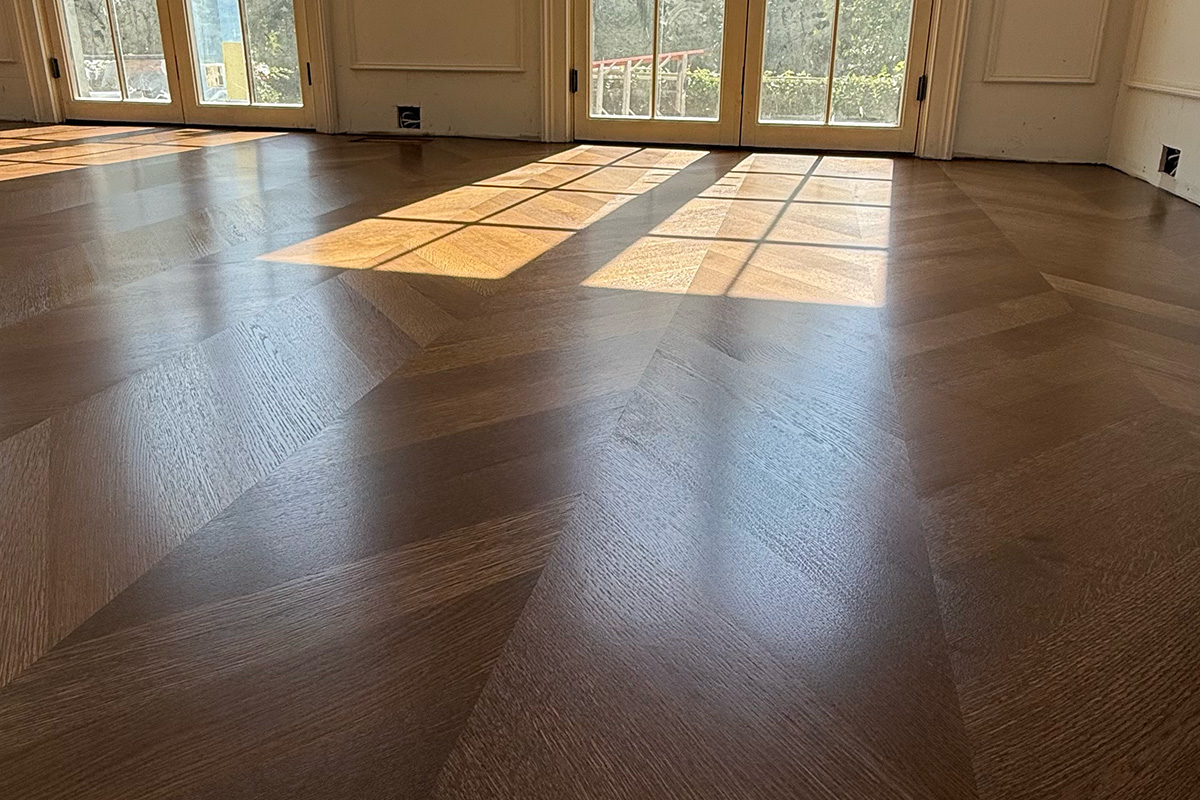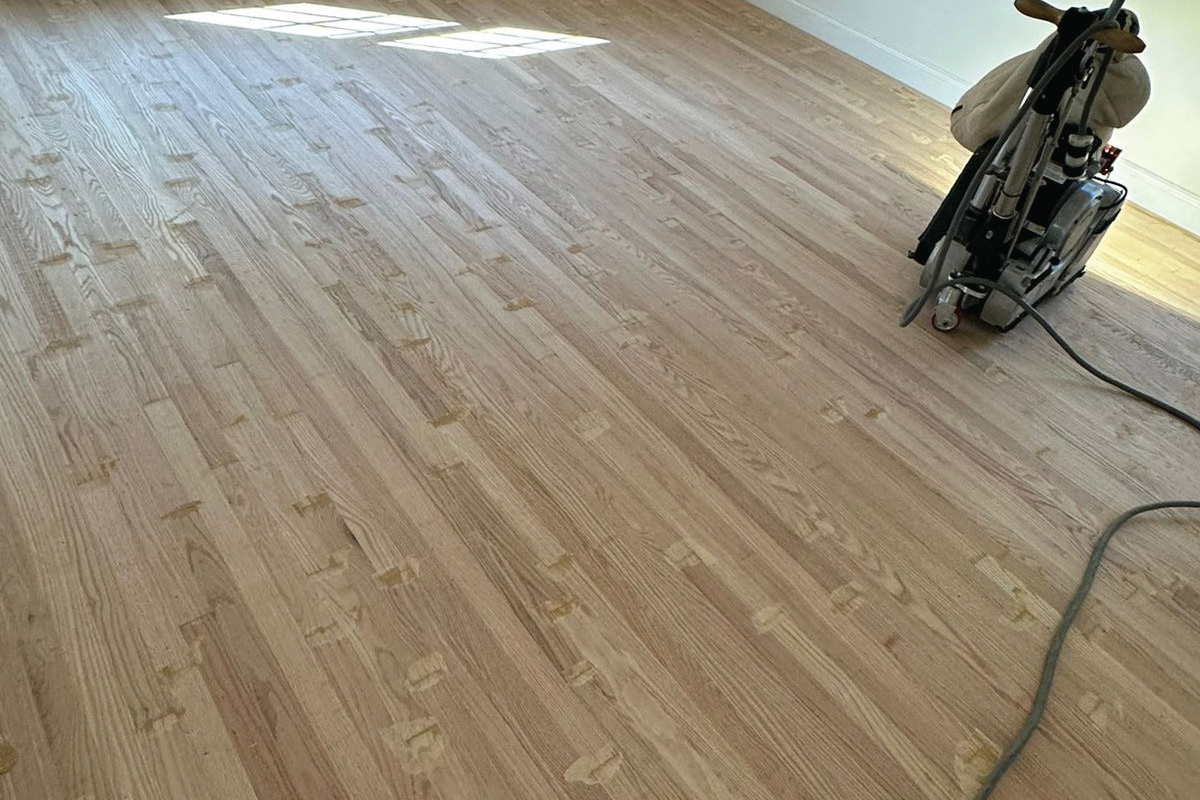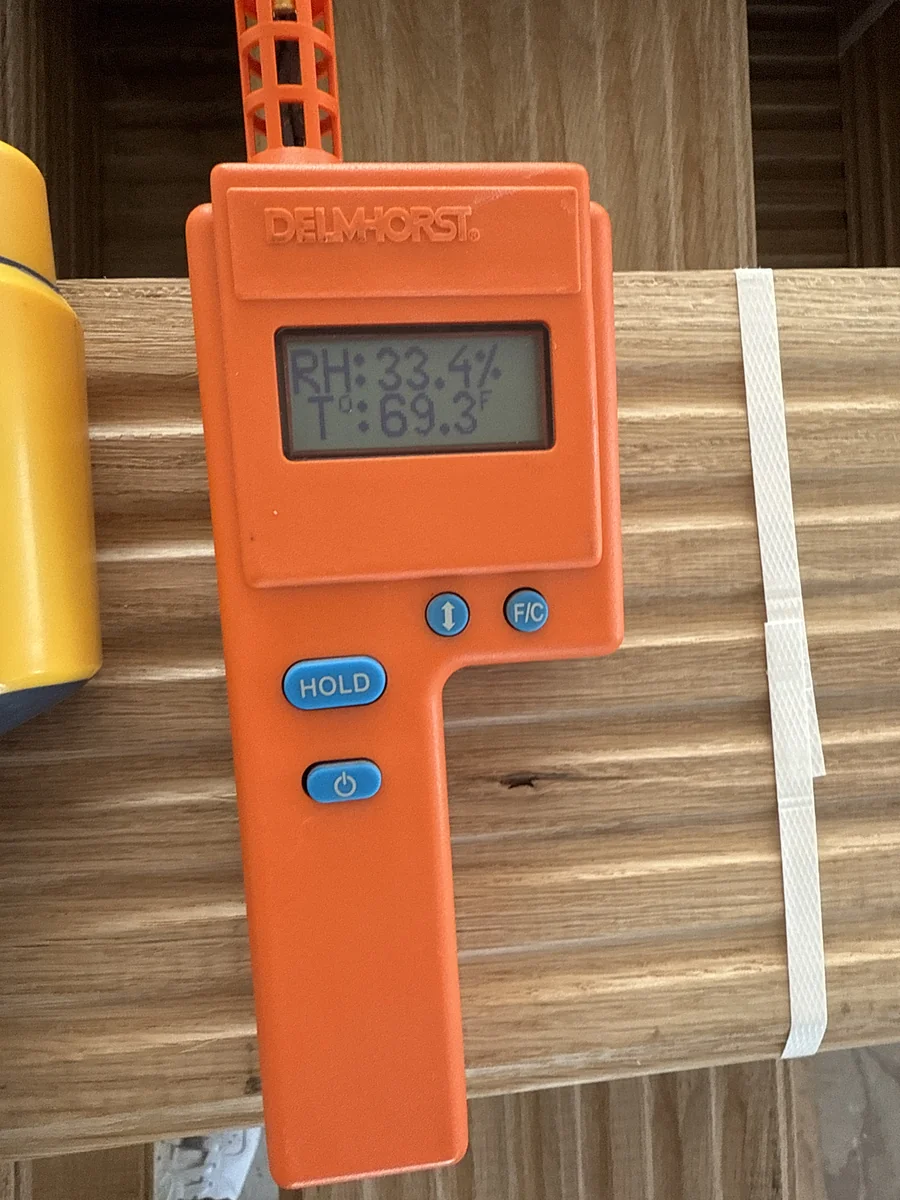
If you collect three estimates on the same floor, they won't match. It's the same room each time, so the spread isn't about size. It's about what's inside the number. Below is what actually drives the cost, and how to tell a quote that's too good to be true from one that reflects real work.
What Refinishing Costs, by Project Size
Bigger jobs cost more overall but less per square foot. A single room runs higher per foot than a full first floor does. Here's the breakdown by space.
| Space | Approx. size | Typical cost |
|---|---|---|
| One bedroom | 200 sq ft | $1,400 – $1,800 |
| Living + dining room | 500 sq ft | $2,800 – $3,800 |
| Typical first floor | 1,000 sq ft | $5,000 – $7,000 |
| Large first floor | 1,500 sq ft | $7,000 – $10,000 |
| Whole house | 2,000+ sq ft | $9,000 – $14,000 |
Small jobs cost more per square foot than big ones, and it's worth knowing why. The truck, the equipment, and the setup and cleanup cost about the same whether the crew is doing one room or five. Spread that cost over more square footage and the per-foot price comes down.
So if you're planning to do one room now and the rest later, it's almost always cheaper to do it all in one visit. That said, if splitting the work into a few trips is what actually fits your life or your budget, that's fine too. We can work in phases when there's a real reason for it.
The Four Things That Actually Move Your Number
Four things move your price more than anything else: the condition of the floor, whether you're changing the color, whether stairs are involved, and repairs hiding under carpet that nobody could have known about.
The condition of the floor
This is the big one. A floor that's dull and lightly scratched sands fast. A floor with deep gouges, pet stains, or gray water marks in the grain takes more passes, more time, and sometimes new boards. Replacing boards adds cost before the sanding even starts.
Whether you're changing the color
Sanding and putting a clear finish back down is the base price. Adding stain adds a full step and a full day. Going from a dark floor to a light one is more work than going light to dark. Custom color matching is more work still.
Stairs
Stairs cost more per square foot than a flat floor does. A staircase is edges, corners, and hand-sanding in tight spaces, and the machines that make flat floors fast weren't built for a tread.
Repairs nobody can see yet
Most floors show us what they need right at the estimate. The exception is carpet — there's no way to know what's underneath until it comes up. When that's a possibility, we walk you through a worst-case number upfront, so it's already priced in.
Something most people don't think about until it's too late: once your floors are refinished, your staircase is going to look dated by comparison. Nothing went wrong. The floors next to it are simply new, and every scuff on those treads suddenly stands out.
Stair and rail work is handled by our stair specialists, a separate trade from the flooring crew, so it's scheduled and priced on its own.
→ Stair and rail systems
On the repair front: when carpet's involved and we genuinely can't know what's underneath, we price for the worst case in the original quote, not after the floor's already exposed. That's the difference between a contractor you can trust and one who surprises you with an invoice.
Not sure what your floor needs?
Free in-home assessments across Monmouth, Mercer, Ocean, and Middlesex counties. See our full sanding and refinishing services.
What Else Is Worth Doing While the Room Is Open
When we refinish your floors, the room gets cleared out and the trim comes off so the crew can sand right up to the wall, done properly. That window closes once the room is furnished again, and it's a good time to bring in our other specialists for trim, paint, or stair work while everything is already exposed.
The shoe molding actually comes off. On most refinishing jobs, nobody pulls the shoe molding at all. The crew just sands as close to it as the machine allows, which leaves a rough edge along the wall and scratches and gouges the bottom few inches of the molding itself. You'll see it the first time you're down at floor level. Pulling the base shoe and quarter round before sanding is standard procedure, not an upgrade, but plenty of crews skip it to save a step. We take it off first, so the floor sands flush to the wall with a clean edge. And since it's already off, you can have it swapped for new trim instead of nailing the same beat-up piece back down.
→ Architectural trim
Painting the trim. New trim gets primed and painted before the floor's final finish coats go down. Our painting crew handles that separately from the flooring crew, and doing it in that order means nobody is taping paint lines onto a brand-new floor finish.
Painting the room, not just the trim. The crews are already coordinating and the room is already cleared out, so this is also a good time for wall painting, not just the trim. That work runs on its own schedule: after the floor's finish has fully cured, not before. Taping off a floor before the finish has cured can pull the finish up when the tape comes off, so any taping near the floor uses tape made specifically for finished wood floors, placed only once the floor is ready, and removed the same day it goes on.
→ Painting services
The stairs. As covered above, our stair specialists can be scheduled at the same time, so the stairs and the floors get handled in one project instead of two.
→ Stair and rail systems
None of this is required. Plenty of our clients do the floors and nothing else, and their floors look great on their own. But if any of it was already on your list for someday, someday is usually cheaper while the room is already torn apart.
What a Cheap Quote Usually Leaves Out
If you collect three estimates, they won't match, and the spread isn't random. Below is usually what's different inside the number.
Whether anyone seals the wood first. A proper finish goes down in three layers: a sealer coat, then two coats of finish. The sealer goes on the bare wood first and does a specific job. It controls how much finish the wood soaks up, so the color comes out even instead of blotchy, and it gives the top coats something solid to bond to.
A cheap job skips the sealer and puts finish straight onto bare wood. You won't notice the difference the day the crew leaves. You'll notice it a few years in, when the finish starts wearing through in the spots you walk on most.
Sealer plus two coats of finish is our standard, built into the base price rather than charged as an extra. A third coat is available as an upgrade for high-traffic areas or homes with pets.
What the finish actually is. We finish every floor with Bona Traffic HD, a premium water-based, low-VOC finish, and our crew is Bona Certified, meaning the manufacturer trained and signed off on how we apply it, not just sold us the product. That matters because a finish is only as good as the person putting it down. Being water-based means two things for you. Your house doesn't smell like a chemical plant for a week, which matters if you have kids, pets, or allergies. And the finish won't amber. Oil-based polyurethane turns golden-orange over time, so if you picked a light white oak, that's not the floor you'll have in five years. Water-based stays the color you chose.

Bona Certified Craftsman — trained and signed off on directly by the manufacturer.
Whether "dustless" means anything. Almost everyone advertises dustless now. Few actually have the equipment for it. There's a real difference between a shop vac taped to a sander and a real containment system with a HEPA-filtered vacuum pulling dust at the source. Ours is rated 99% dust-free, and it's standard on every job, not an add-on.
“I have asthma and allergies so I was concerned about the dust factor … I was shocked how dustless my house was once they were done.”
Cheryl Strom, Google Review
Whether they skip grits. Sanding is a sequence, coarse to fine, one step at a time. Skipping a grit saves an hour and leaves scratch marks under the finish. You won't see them the day the crew leaves. You'll see them the first morning the sun hits the floor at an angle, and by then the only fix is starting over.
How you pick your color. Some contractors hand you a color chart and hope for the best. We bring samples of the stains you're considering and apply them directly to your own floor, so you see the actual color on your own wood, in your own light, next to your own walls. Stain reads differently on every floor. A chart can't show you that.
Whether anyone calls you. Contractors go dark on a job all the time. Everyone has a story like that. Someone from our office checks in with you every day the crew is working in your house, so you're never left wondering what's happening.
Who comes back if something goes wrong. That's really a question about the warranty, which is worth its own section.
The Warranty Is the Whole Point
Our finish carries a 10-year warranty. A warranty is only worth as much as the company standing behind it, which is worth thinking about before you sign anything.
There's a difference between a workmanship issue and a warranty claim, and it's worth knowing which one you're dealing with. If something's off because of how the job was done, we come back and fix it. That's not a warranty question, that's just doing the job right. The 10-year warranty specifically covers the finish itself, a defect in the product, backed by the manufacturer on top of us backing our own labor.
A contractor who's been in business for three years can print "10-year warranty" on any invoice. It costs them nothing to promise, because there's a real chance nobody's around to answer for it in ten years.
We've been doing this in New Jersey since 1951, now in our third generation. If something goes wrong with your floor in 2036, there will be somebody here to pick up the phone.
That's the real reason a company's age matters here. It's not about nostalgia. It's about having somewhere to turn if you need to.
The Cheapest Way to Redo Your Floors
If your floors are dull but not damaged, a buff and recoat might be all you need instead of a full refinish, at roughly half the price, as long as the existing finish is still intact.
A buff and recoat lightly abrades the existing finish and applies a fresh coat over it. No stain, no full sand, no bare wood involved. It typically runs $2 to $3 per square foot, about half the cost of a full refinish, and is usually finished in a day.
The catch is that it only works if the finish is still intact. If there's bare wood showing anywhere, gray traffic lanes, or scratches deep enough to catch a fingernail, a recoat just seals the damage in instead of removing it, and you'll have spent the money without solving the problem.
We'll tell you which one you actually need. Sometimes that means talking you out of the more expensive job.
→ More on deep cleaning and recoating
Is It Cheaper to Refinish or Replace?
Almost always, yes. Refinishing costs less than replacing, and if the wood underneath is sound, it usually gives you the better floor too.
New hardwood runs about $8 to $15 per square foot in New Jersey for the floor itself, supplied and fitted, before removal or finishing. Refinishing runs $4 to $8. On a 1,000 square foot floor, that gap can be several thousand dollars.
→ What hardwood floor installation costs, line by line
Refinishing often gives you the better floor outright. The old-growth oak common in a 1940s Monmouth County home is denser and tighter-grained than most of what's sold new today. If it's sound, it's worth saving.
The exception is when the wood has gotten too thin to sand again. The National Wood Flooring Association's guideline is about 3/32 of an inch of wood remaining above the tongue and groove, roughly two quarters stacked, for a floor to safely take another sanding. Less than that, and the sander cuts through into the tongue and groove itself.
We check that before we quote, not after.
→ What a real floor assessment looks like
One Note About New Jersey
Labor costs here run well above the national average, so the low numbers on national cost-estimator sites usually don't reflect what a contractor in Monmouth County can actually deliver the work for.
If a quote comes in under $3.50 a square foot, something has been left out. Ask what.
We sand and refinish hardwood floors in Holmdel, Middletown, Red Bank, Rumson, and Colts Neck, and across Monmouth, Mercer, Ocean, Middlesex, and surrounding counties.